
My teen loves Duolingo. He’s currently learning Spanish, French, Portuguese, Norwegian, Hebrew and Japanese on it.
As a Spanish and French to English translator, languages are naturally really important to me and I’ve spent many years honing my language skills.
I was lucky enough to be able to learn 3 languages at school – French, German and Latin.
Due to a lack of language teachers, my son can only learn one language at his school, and he doesn’t get to choose which one. He’s doing French.
So I don’t see anything wrong with him learning languages with DuoLingo. I’m just pleased that he wants to learn any and, in Duolingo speak, he’s “committed” – spending 10-15 minutes on one or two of his many languages every day.

Now it’s my turn to learn languages on DuoLingo
We go on holiday to Italy a lot, so I’d been talking about learning Italian for years.
With my son’s encouragement, I started learning it on Duolingo a few months ago and recently started to feel like I might be making some progress.
So I thought I might as well use it to brush up on my German, too. I studied German at University but haven’t used it since a trip to Vienna 20 odd years ago.
Although pretty rusty, I know it’s all still in there somewhere, so I skipped ahead a few lessons. I have to admit, I’m finding it quite useful just to get back into the sound and rhythm of it.
Then I came across the following ‘translation exercise’:
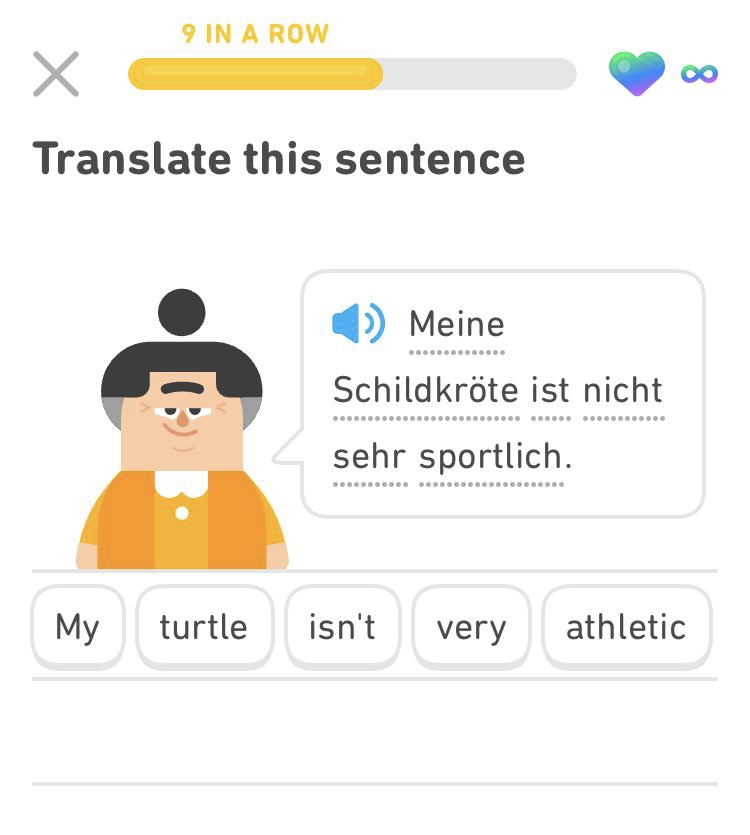
“Turtle” isn’t a word that featured heavily throughout German GCSE, A Level or even my degree, I have to say.
And, as for describing my “Schildkröte” (I do love the sound of that word!) as not very athletic, well…
Still, I appreciate that one day, some turtle owner somewhere may need to say these words.
Unlike an exercise my son showed me in his Norwegian lessons, when he had to translate “I am the cheese” into Norwegian.
DuoLingo, however, state that there’s method to their madness. In a blog post from 2021, they say:
“Quirky sentences also have a hidden superpower: they are memorable! They work as a grammatical ‘anchor’, helping you remember key examples of essential grammar concepts.”
James Leow, Jacqueline Bialostozky & Cindy Blanco, duolingo
Using AI in language learning
I’m not sure if I’m convinced, especially since discovering that DuoLingo uses AI to construct its exercises (of course it does!).
It’s even created its very own machine learning model, aka AI tool, ‘Birdbrain‘.
According to this post published a year ago, “until now, every single exercise chosen by Birdbrain was written, reviewed, edited, and translated by human experts”.
Hurray! We translators aren’t out of a job yet.
Except…wait. It goes on to say: “Today, we’ve moved into using AI to create these exercises”.
Aargh. They still get humans to write the prompts, though. That’s a relief.
However, I’m pretty sure that if these same humans also had to check whatever Birdbrain creates now, phrases like the ones my son and I have come across recently probably wouldn’t have made the final cut.
Do you/your kids learn any languages on Duolingo? Got any gems like this one that you’d like to share?! Leave me a comment below!
 Judith Zerdin