
My dad’s maternal grandmother was born in Poland. When my son discovered this, he decided he had to learn Polish on DuoLingo. He tried to teach me a few words and phrases. Mleko (milk) is the only thing that’s stuck – I can add that to zloty, which is the only word I remember from my one trip to Poland in 1998.
Anyway, neither of us thought we’d be using his/my extremely limited knowledge of Polish any time soon – until we went on our summer holiday this year. (Not to Poland, I should add.)
We did go to Slovakia, though. One morning in Bratislava, my son and I went to a supermarket to buy milk. Shouldn’t be too hard, you might think. But how to differentiate milk from cream/milkshakes/general milk drinks? They all looked the same, and I had no idea what the word for milk was in Slovakian. Before I could turn to Google Translate, my son spied a carton that said Mlieko.
“This must be milk,” he said. “It’s just like the Polish, mleko.” True enough, it was milk. Thanks, DuoLingo!
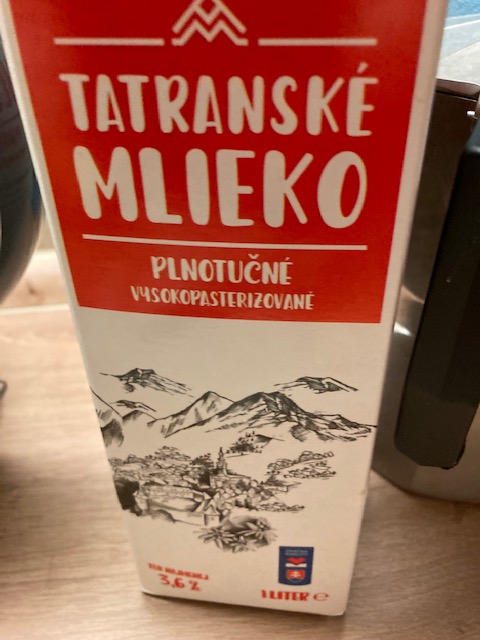
(Not surprisingly, I later learnt that ‘milk’ in Czech is also very similar: mléko. Just don’t ask me if it’s pronounced any differently!)
You want cream with that?
However, another day, we had to look for something a bit trickier – the Slovakian equivalent to crème fraiche. I’d (bravely/optimistically/foolishly?) decided to make carbonara for dinner, and I prefer to use crème fraiche over cream (I know, I know, Italians would berate me for even thinking of putting any cream-like substance in a carbonara, but that’s how I make it).
Thinking about it now, good old cream might have been easier to find, because I didn’t understand any of the different types of cream on display. But then I spied a not-very-friendly-looking shop assistant was stacking shelves nearby so I decided to try her.
“Carbonara?” I asked gingerly. A massive smile appeared on her up-till-now-poker-face. “Ah, carbonara!” she said, nodding enthusiastically and pointing to a pot of something called Smotana Na SL’ahanie that had a picture of what looked like whipped cream. It didn’t exactly look like crème fraiche, but she seemed to think it should go in a carbonara, so I bought it.
Unfortunately, the carbonara was a total disaster – the saucepans in our Airbnb weren’t big enough to make enough spaghetti for 6 people, the bacon was all wrong and, to top it off, the ‘crème fraiche’ I’d cheerfully bought did indeed turn out to be whipping cream. (The picture on the front gave it away, really.)
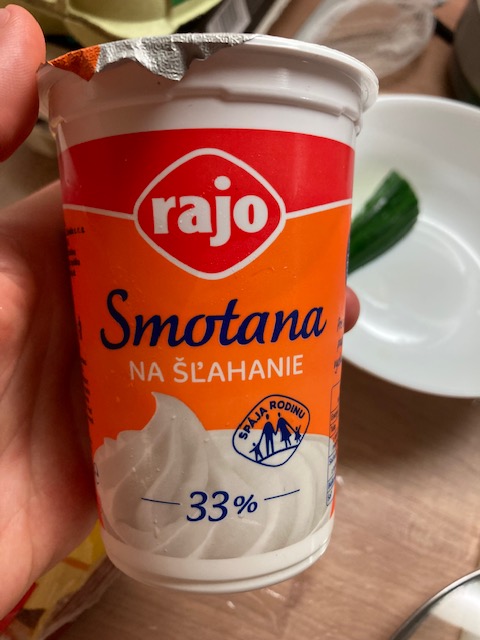
Looking back, I can see a similarity between the Slovakian word for what must be “whipping” = Na SL’ahanie and the German word Schlagsahne, that, in Austria, means whipped cream. Would have been helpful if I’d noticed that in the shop – but I still wouldn’t have got closer to finding the elusive crème fraiche!
An egg-sperience not to be repeated
Fast forward a few days and we were in a supermarket in the outskirts of Prague. I mention the outskirts because they probably didn’t have many English speaking tourists popping in there for provisions. I was at the one and only checkout with a long queue of people behind me when I suddenly remembered our staple Airbnb breakfast ingredient – eggs.

In Sainsburys, if you remember something at the last minute, you just quickly mutter to the checkout assistant, or the next person in the queue, “Really sorry, I’ve forgotten something – back in a sec!” – and rush off to find it. Eggs are usually somewhere near the baking ingredients, so you grab a box, sprint back, job done.
Not in Czech supermarkets. Oh no.
Not only could I not remember seeing them anywhere, but I also didn’t have the foggiest notion of how to say “eggs” in Czech. In a panic, I spotted a girl in the supermarket’s uniform, pacing down an aisle towards a store cupboard. I quickly Googled “how to say eggs in Czech”, (vejce, in case you were wondering – but I obviously had no idea how to pronounce that) and ran after her.
“Excuse me!” I said rather loudly.
She turned around in surprise, and I wielded my phone at her. I hated having to do it – as a language professional, relying on Google to communicate instead of managing to say it myself was, frankly, horrible – but I had no choice, especially with a queue of irritated people waiting for me at the checkout.
She looked annoyed and said something in Czech, presumably telling me where to find the eggs. Of course, I couldn’t understand, but why couldn’t she just take me there?!
I shrugged. “I don’t understand, sorry. Where are they?”
She let out an exasperated sigh and, throwing her hands in the air, strutted off down the aisle – in the direction of the eggs, I hoped – muttering something about English, as the only word I understood was Anglický (Czech for “English”).
I felt I had to stick up for myself, even though she wasn’t going to understand me. “Sorry, I don’t speak Czech!” I said, as I almost ran to keep up with her.
She took me to where the vejce obviously were – duh – next to the cheese, of course, in the refrigerated dairy cabinet. Makes sense, I suppose.
After that little run-in, I asked my son (who by now had added Czech to his DuoLingo languages) how to say “I’m sorry, I don’t understand Czech” – but it was so difficult to remember that I’m glad I didn’t need to say it, as most people in Prague seemed to speak (or at least understand) a smattering of Anglický.
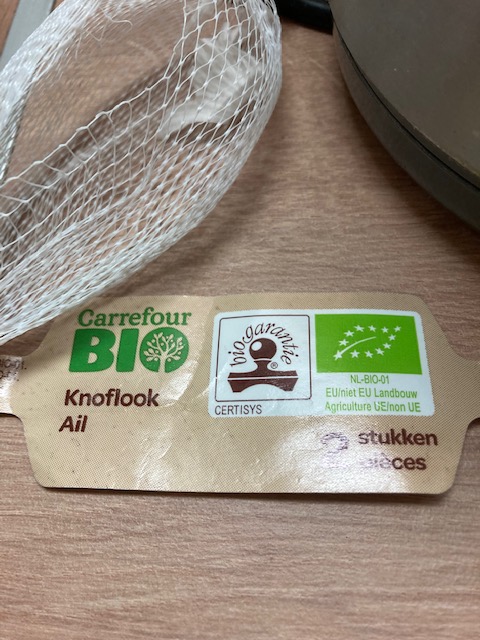
I find the connections between different languages so intriguing. Aside from the similarities between Slavic languages, I loved discovering that, in Belgium, “garlic” was Knoflook in Flemish. You can clearly see the link between that and its German equivalent, Knoblauch.
Veering slightly off piste, this reminds me of when I was on a language exchange in French-speaking Switzerland as a teenager and asked the changing room attendant in a swimming pool where the assiettes (plates) were, instead of serviettes (towels). I couldn’t work out why she was giving me such a strange look.
Or when, on holiday in Austria with my parents once, we ended up in a cemetery when we were meant to be visiting a monastery – because my Mum had seen the sign for Friedhof (cemetery) and assumed that must be a monastery, as “it’s something to do with ‘peace’!” (Friede in German means peace, as in the opposite of war…Anyway. I’ll just leave that there.)
Have you had any amusing/embarrassing experiences abroad trying to fathom out words when you’re not familiar with the language? I’d love to hear about them – leave me a comment!
 Judith Zerdin