
“Is your mother fat or thin?”
“Wie, bitte?” (which can be loosely translated in this scenario as “Come again?!”)
“Is your mother like you, or like me?”
“Oh. She’s like me.”
“Ach.” (Tuts disapprovingly.)
The above dialogue – all in German – took place in a lift in Zurich airport.
The person asking the questions was the stick-thin mother of my German exchange partner.
The person the questions were directed at was 17-year-old me (neither fat nor thin, I hasten to add).
I’d just spent 10 days with this family at their home near Lake Constance in the very far south of Germany, near the Swiss border, and it had been the most unpleasant experience of my life.
I think this was the most the mother – let’s call her Frau M – had deigned to say to me directly since Day 3. (Although she had managed to complain that she’d put on weight because she had to cook dinner for me “every day”.)
It seems she was trying to make conversation with me in the lift, but implying anyone – let alone a 17-year-old girl – is overweight really isn’t the best way of going about it.
Luckily, I was on my way home from my seventh – and very much final – language exchange.
My school organised an exchange every year from Year 9 upwards and, because I did both French and German for GCSE and A level, I ended up going on three organised by the school, and four that I arranged privately.
Things are very different now. My son’s doing French for GCSE, which I’m obviously very happy about, but I find it a real shame that his school isn’t organising any trips to French-speaking countries as part of it.
When I asked his French teacher whether there were any trips or exchanges, she shook her head sadly and said they didn’t “do that any more”.
I guess you can put it down to a mixture of DBS checks, health and safety assessments and general distrust of pretty much everyone nowadays.
For me, they were always slightly terrifying, and it was always pot luck as to whether I’d click with my exchange partner or not, but they were a great way to learn the language and experience other cultures.
Exchange No. 1: France – Easter 1990
My very first exchange took place during the Easter holidays of Year 9, when my school offered a two-week French exchange with children from a school about 30 miles west of Paris.
Céline, my exchange partner, was nearly 16; I’d just turned 14. That’s quite a big gap at that age.
She spent her holidays cooking, doing homework and watching TV, and didn’t seem to want to hang around much with me.
I spent most of the time reading on my bed, playing board games with her younger brother and sister, François and Anne, and watching American shows dubbed into French on TV. I was very bored.
One of the first things I learned on this exchange was to leave my English customs – such as drinking tea – at home.
On my first day, for example, Céline’s mum asked me if I’d like tea for breakfast. I naively said yes please, so that day they took me to a supermarket to buy a packet of Lipton’s teabags.
At breakfast the next morning, she carefully warmed some water up in a bowl in the microwave, submerged a teabag for a few seconds, took it out, and handed it to me. I can’t remember if she added milk or not, but it didn’t really matter.
Merci, I said, smiling politely. After that, I asked for coffee.
“At breakfast, she carefully warmed some water up in a bowl in the microwave, submerged a teabag for a few seconds, took it out, and handed it to me”
We’d been strictly told by our teachers that there was to be no contact with our families in the UK, or indeed our other friends also on the exchange, apart from on the first night when I was allowed to call home on the house phone to tell them I’d arrived safely.
Of course, this was before mobile phones or even the internet, so it wasn’t hard to not be in touch with anyone.
I did see one school friend, once – Susie – whose exchange partner was friends with mine and lived in the same small town. It was a drizzly Good Friday, and the four of us went on a 15km bike ride.
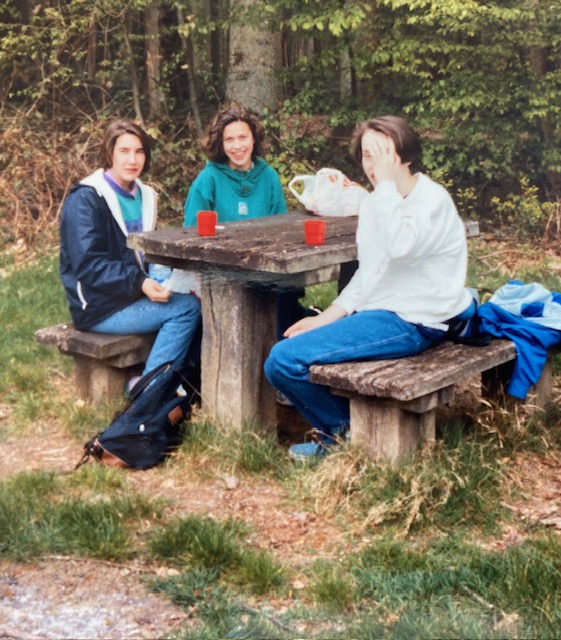
At the halfway point we sat down at a wooden table by a forest and Céline and her friend, Delphine, served up the picnic lunch that we’d all brought with us.
I was just tucking into a rice salad Delphine had made when I noticed I was eating something that looked suspiciously like a claw. I asked what it was and Delphine replied that it was crab (I throw up when I eat shellfish). Oh well, I thought – hopefully I didn’t eat much.
When we got back home I felt absolutely exhausted and Céline’s mother ran a bath for me.
However, I never made it into the bath because I spent the next couple of hours running to and from the loo, vomiting like there was no tomorrow.
Being ill added to my homesickness, but it never occurred to me to ask if I could phone home and let them know what had happened – and Céline’s family didn’t suggest it either.
The family asked me if there was anything in Paris I’d like to visit. I’d been to Paris many times before and had already done all the obvious touristy things. However, there was one place I hadn’t been to that I wanted to see.
“The Louvre,” I told them. They nodded. The next day we drove to Paris for the afternoon but not to Louvre – instead we went to Les Invalides, which I didn’t find that interesting, although we did see Napoleon’s tomb.
As we were driving home we passed a huge building. “There’s the Louvre!” they said. That was all I got to see of it. (I did get to visit it properly a few years later!)
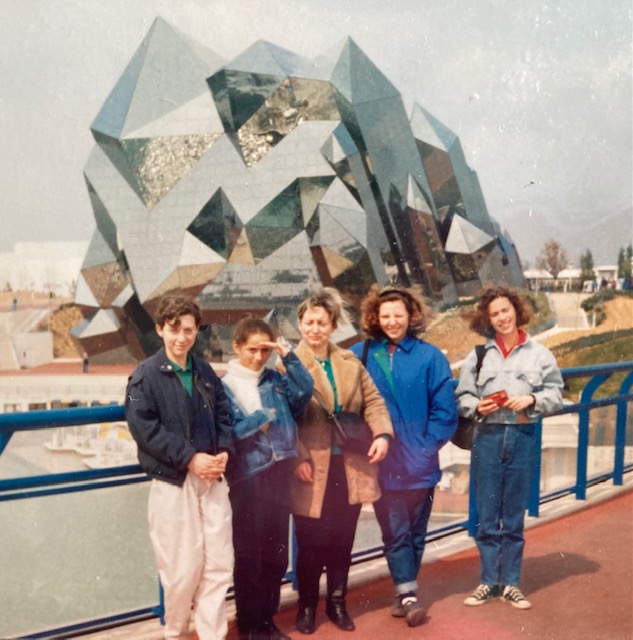
The best thing we did was right at the end of my stay. We spent the day at Futuroscope, a kind of theme park built around cinemas near Poitiers, some 320km away.
We left the house at 6.15am and arrived four hours later.
Bear in mind that there were six of us – two adults, one kid and three teenagers – squashed into a 5-seater hatchback (this was in the days before compulsory seatbelts in the back!) so it was a pretty uncomfortable journey (for us in the back, anyway).
The cinemas were great, though – each one consisted of a short film and a different experience – for example, there was a 3D one, a 360 degree one and the best, for me, a “roller-coaster” cinema where the seats moved as you followed a track on the huge screen in front of you, to make you feel like you were on a real rollercoaster.
What stands out among my memories that day was one of the snacks we ate. Céline’s mother handed out baguette sandwiches, which I discovered had nothing inside them except a couple of squares of milk chocolate.
Céline and her siblings thought this was the treat of all treats (apparently, it’s a typical snack for le goûter, the French equivalent to kids’ tea-time) but I just thought it was weird. However, I’m a Marmite devotee, so each to their own.
When Céline came to London that summer, we treated her to a week on the north Devon coast in a beach chalet and then a week exploring London.
But she managed to develop a strong attachment to my older brother and made it clear she wanted to spend all her time with him rather than me, much to my annoyance.
Unsurprisingly, she was keen to repeat the exchange the year after, but I had a good excuse not to go back (not that I would have anyway….).
I was off to Germany.
Exchange No 2: Germany (Hamburg) – August 1991
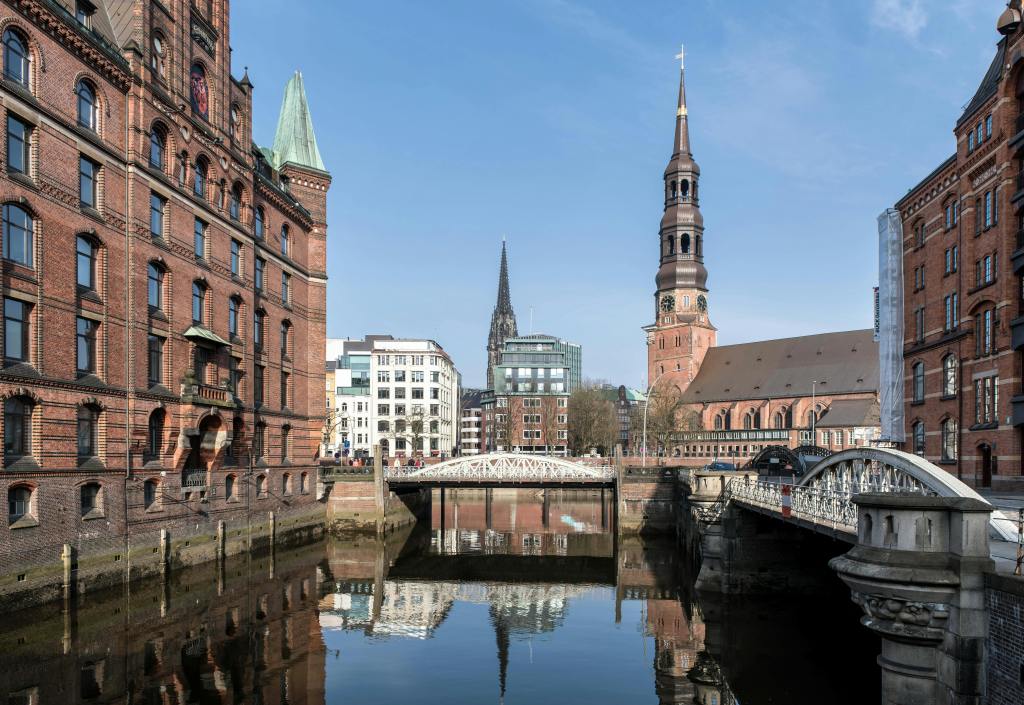
My German exchange partner, Julia, had already been to stay with me in London for two weeks that Easter, so hers was a familiar face when I landed at Hamburg airport in August 1991. She lived in a house with a triangular, pointy roof in Volksdorf, a quiet, well-to-do suburb of Hamburg.
I’d only been learning German for a year so communication was hard at first, although her parents were lovely.
This exchange was once again through my school, but this time it was organised by St Paul’s Boys, and there were no restrictions on contacting or seeing anybody.
This made a huge difference as it meant I could see my friends, and all the English and German students spent three days in Berlin together on an trip organised by the schools.
As a result I’m not sure how much my German actually improved – unlike my French the year before, as I’d been totally immersed with Céline’s family – but I had a much better time with no chance to feel bored or homesick.
As it was August the German teenagers were already back at school, so our mornings were spent at school with them and our afternoons were free.
One afternoon a whole bunch of us – Germans and English – decided to go and rent canoes somewhere.
I ended up in a canoe with Susie, the friend I’d been on the vomit-inducing French bike ride with the previous year. Neither of us had a clue how to handle a canoe – and we ended up ramming it into every possible tree on the riverbank.
I think the river was supposed to lead to a lake, but we never got there. My arm was torn to shreds from the branches, but I hadn’t laughed so much in ages.
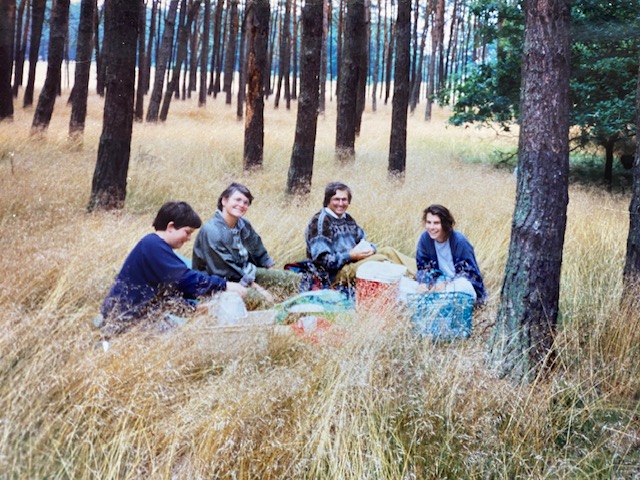
On the first weekend, Julia’s family took me to Lauenburg, a town on the former east-west German border. We picnicked in a deserted pine forest before finding an old watch tower, built on a platform overlooking the river Elbe.
Julia’s Mum explained to me that they cut down all the hedges along the river so they could see if anyone tried to cross it from the watch tower, and then shoot them.
There was also an old, very high fence, which kept people from that village within the boundaries.
My day-trip to the former GDR left quite an impression on me, but my eyes were opened even wider on our three-day trip to Berlin the following week.
The Berlin wall had only come down two years before and there was a lot still standing – in some stretches, miles of it.
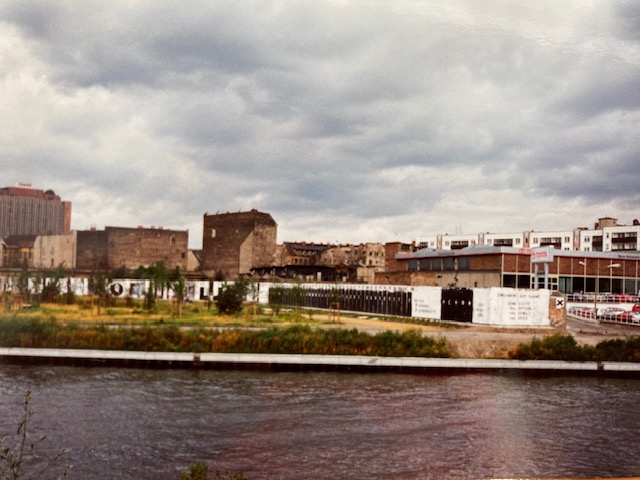
We stayed in a youth hostel on the former west side, and did the usual things: we saw Checkpoint Charlie, the Brandenburg Gate and the Bundestag; we went shopping and to a disco one night.
We also visited a concentration camp as well as the huge Olympic stadium, built to host the infamous 1936 Olympics. The visit culminated in a boat trip to the city of Potsdam, just outside Berlin.
Back in Hamburg, lots of house parties and barbecues ensued and I barely saw Julia. She was pleasant enough, but we didn’t have that much in common and didn’t keep in contact after I went home.
Exchange No 3: Austria (Innsbruck) – Easter 1992
Fast forward to Easter 1992 and I was off on yet another German-speaking exchange, this time to Austria. I’d arranged it myself with my Austrian penfriend, Michaela, or Michi, as everyone called her.
She lived in a flat in the Tirolean city of Innsbruck with her parents, older sister and younger brother. We were the same age – just a couple of weeks apart – and we really clicked.
I was about to start my GCSEs so I’d brought all my revision with me and I remember studying in the mornings, while Michi was at school – although sometimes I went with her.
I remember her mum coming in to my room once while I was studying and commenting: “Judith, du bist so fleissig!” – Judith, you’re so hard-working! – and I thought, well I haven’t got much choice!
Michi and I did lots of things together in the afternoons: we took a cable car up one of the snowy mountains overlooking the city, we visited the Alpine Zoo, we went to the cinema to see the film Hook dubbed into German, and took a bus to a disco in a neighbouring village at 5pm on a Sunday (where the boys asked the girls to dance – and I had my first slow dance with one of them).
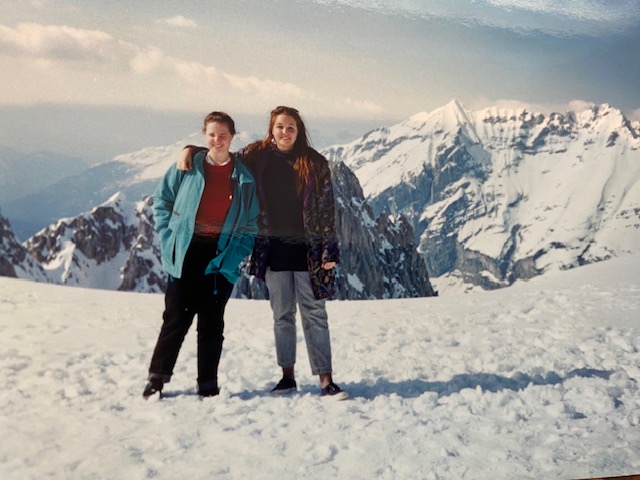
Her family delighted in introducing me to various Tirolean/Austrian culinary delicacies (her mum showed me how to make Wienerschnitzel, as she knew it was one of my favourite dishes) and the Tiroler Dialekt (Tirolean dialect).
They laughed (good-naturedly!) at the Hochdeutsch I spoke, the type of German that I’d been taught at school, and were fiercely proud of their own culture and dialect.
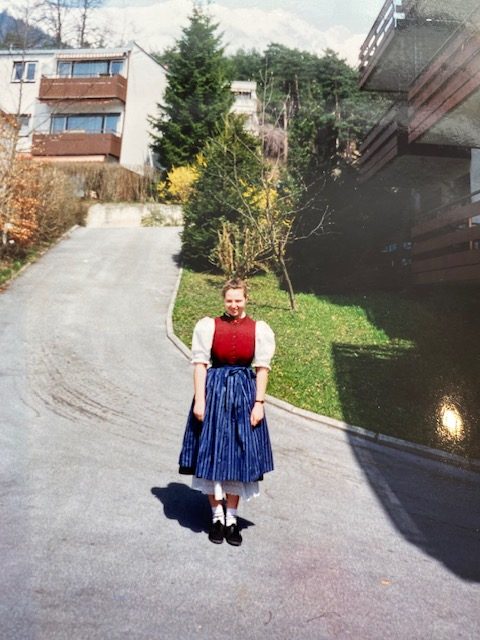
I can still remember some of the Tiroler Dialekt they taught me, one noteworthy expression being – “so ischs!” (short for “so ist das Leben”, a sort of equivalent to the modern-day “wha’ever!”)
They made fun of the Germans, the Swiss and even the Viennese – but not as much as the people who came from Vorarlberg, Austria’s westernmost state and their immediate neighbour – who were the butt of most of their jokes.
“They made fun of the Germans, the Swiss and even the Viennese – but not as much as the people who came from Vorarlberg, who were the butt of most of their jokes”
Michi returned the visit the following summer, and we had a great time seeing London together.
I also introduced her to one of my favourite childhood films, The Sound of Music, which, like many Austrians, she had never heard of.
She watched the movie with me but pronounced it “ein bißchen schmalzig” (a bit over-sentimental). Harumph!
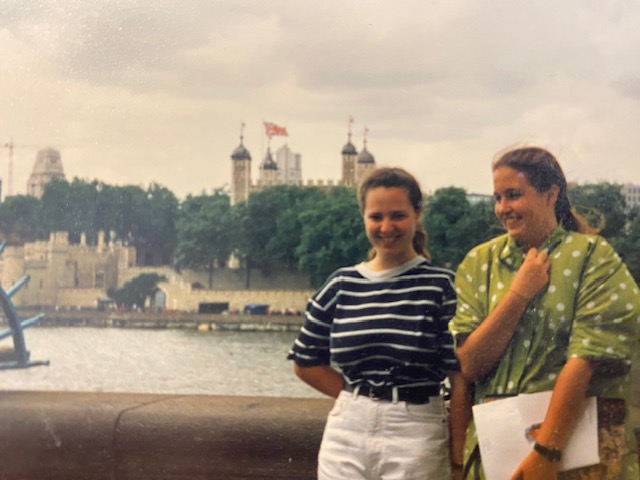
However, she embraced all things British and, to my delight, took an instant liking to tea (I’d learned my lesson and had only drunk coffee in Austria) as well as custard creams. I took her a packet as a present when I went to visit her again that December, after my next exchange, which was to Munich.
Exchange No 4: Germany (Munich) – December 1992
If Julia in Hamburg and I had had little in common, Steffi, my exchange partner in Munich, and I had even less. Apart from the fact that we both had a dog, there was precious little else. We also had to share a bedroom for the week that I was there, which was shortly before Christmas 1992.
Luckily though, I ended up seeing very little of Steffi. She lived in Gauting, a suburb of Munich, but all I remember about being there was having to get up early after very little sleep (this was also organised by St Paul’s Boys, but now we were older there was a lot of staying out till very late), having cake for breakfast on Steffi’s birthday, and black tea poured from a transparent teapot, and candles on the breakfast table, which made the icy mornings feel very cosy.
The highlights of this exchange were the outings and the social life. I knew quite a few of the St Paul’s boys from the Hamburg exchange, and yet again I was with Susie, as well as two other school friends also doing A level German.
The German school organised activities for us the whole week, which included a day in the town of Ingolstadt, where we did a tour of the Audi factory (yawn), a visit to the printing works of the Süddeutsche Zeitung [newspaper] (double yawn), a tour of Munich’s famous Löwenbräu brewery and an afternoon of sports at school.
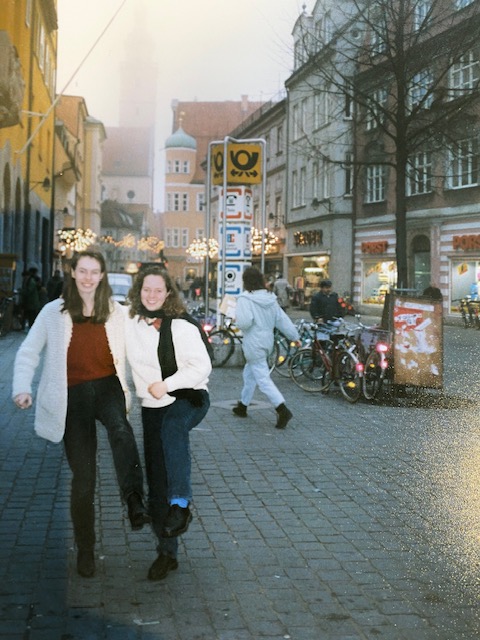
We also spent a lot of time in McDonalds. It was freezing cold and, being students, we were all on a limited budget. One day, we went there four times.
But we also saw the sights of Munich and spent time buying Christmas presents at the festive Christkindl market laid out in front of the city hall.
Every shop I entered seemed to be playing I’m Dreaming of a White Christmas, which always reminds me of my Munich exchange.
On my last day, instead of heading back to the airport with the others, I caught the train to Innsbruck to spend a couple of days with Michaela and her family (and give her the custard creams).
Steffi dutifully accompanied me to Munich’s Hauptbahnhof on the local train. I wrote in my diary: “We didn’t exchange a syllable the whole journey. I couldn’t think of anything to say, and Steffi was ‘tired’. [We had gone to bed at 2am the night before!] Oh well.”
“We didn’t exchange a syllable the whole journey. I couldn’t think of anything to say, and Steffi was ‘tired’. Oh well.”
1993: Three exchanges in one year!
I was now in the lower sixth, studying French and German for A level, and it was a constant struggle between which language I was stronger in.
By 1993 I’d done three German-speaking exchanges and only one to France, so I decided it was time to polish up my French.
Exchange No 5: Switzerland (Fribourg) – Easter 1993
Some friends of my parents knew a family who lived in the city of Fribourg in the (just) French-speaking part of Switzerland, whose son, my age, was keen to do an exchange – or at least his parents were keen for him to.
They put us in touch and my mum arranged for me to spend two weeks at Easter there and for Martin, their son, to come to London in October when he had holidays, which coincided with my half term.
However, when I arrived in Fribourg I discovered that it’s actually a bilingual city and, although the predominant language is French, and despite Martin’s family all being able to speak French, the language they spoke at home was Swiss German.
I found out that this was because his dad was from the German-speaking part of Switzerland – and his mum was German! So much for a ‘French’ exchange…
The family were a little bit formal but still welcoming, and made an effort to only speak to me in French.
The rest of the time they conversed with each other in Swiss German, which was nothing like the German I knew and I could barely understand a word.
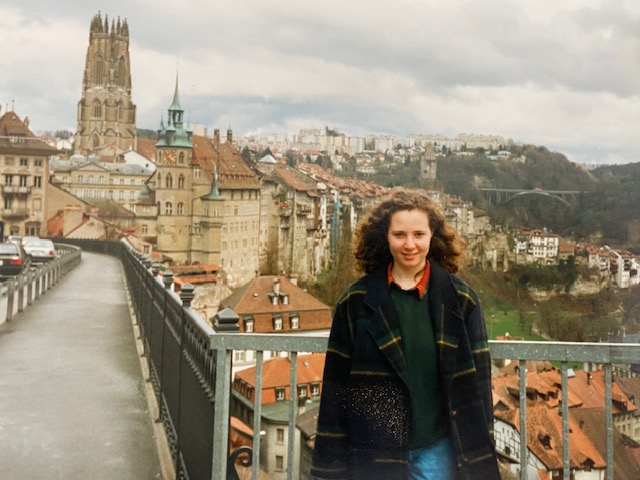
I didn’t really see much of Martin – he sang in a choir and always seemed to be busy having rehearsals – but I had some enjoyable day trips with his parents and younger sister, Melanie, who I got on very well with.
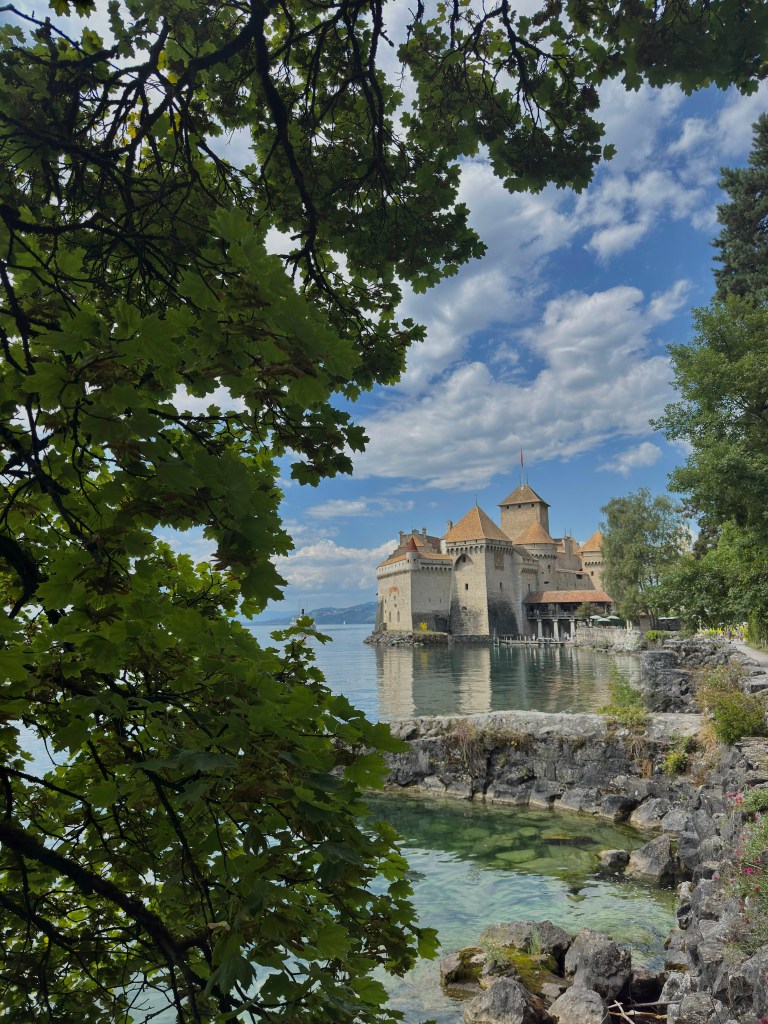
Among the places we visited were Gruyères, where the stinky cheese comes from (I’m not keen on it, but the town was very picturesque), the cities of Lausanne and Montreux and the beautifully-located Château de Chillon on Lake Geneva.
I did spend one day with Martin, when we went to the capital, Berne, to go sightseeing with a couple of his (French-speaking) friends.
However, I didn’t enjoy it because they all spoke so fast that I couldn’t understand enough to join in with their conversation and I got really bored, in the end just tagging along behind them and wishing I was elsewhere.
“I did spend one day with Martin, when we went to Berne to go sightseeing with a couple of his friends. However, I didn’t enjoy it because they all spoke so fast I couldn’t understand enough to join in with the conversation and I got really bored”
At Geneva airport, on my way home, I met up for a coffee with Ariane, a girl roughly my age from Geneva, and her mum.
Ariane’s parents knew my piano teacher in London and had got in touch with her asking if she knew an English family who wanted to do a language exchange.
Why my piano teacher thought of me, I have no idea….
Exchange No 6: Switzerland (Geneva) – Summer 1993
…so this lead to my sixth exchange. It was arranged that Ariane would come to London and spend two weeks with me that July, then we’d both fly back to Geneva together and spend two weeks with her family.
We just had to hope we wouldn’t end up hating each other after being together four weeks on the trot!
Luckily we got on fine, as she was a very easy-going person, and her family were absolutely lovely.
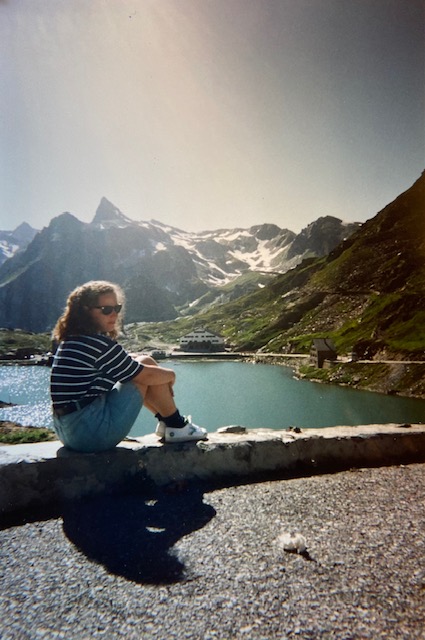
On arrival in Geneva, her parents met us at the airport and we went straight to their wooden chalet in La Fouly, a tiny village in the Alps, where I met her older sister, Séverine, and her boyfriend.
We spent a week there and it was just gorgeous – it felt like a real holiday.
The highlight of the week was when her parents arranged, as a surprise for Séverine’s 21st birthday, for me, Ariane, Séverine and her boyfriend to go in a little six-seater plane that flew us over the Alps to and around the Matterhorn (or Cervin, in French), the famous pyramid-shaped mountain.
As if that wasn’t enough for one day, after we landed we went swimming in the glorious open-air thermal baths at nearby Saillon.
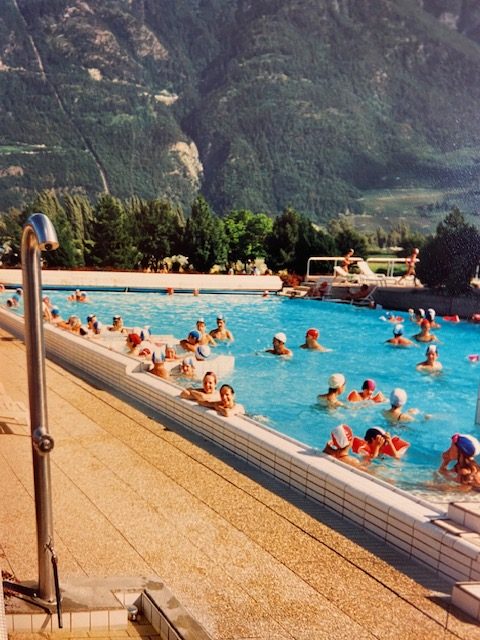
Another highlight was spending a day hiking through the mountains into Italy, which was totally exhilarating and exhausting – I got sunburnt in places I didn’t even know you could get sunburnt in.
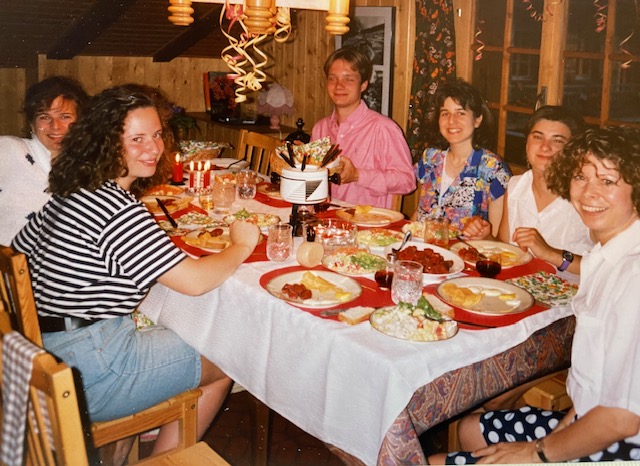
I also fondly remember an evening playing board games with the family, eating fresh mushrooms that they’d foraged in the woods and sharing a Fondue with everyone in the chalet.
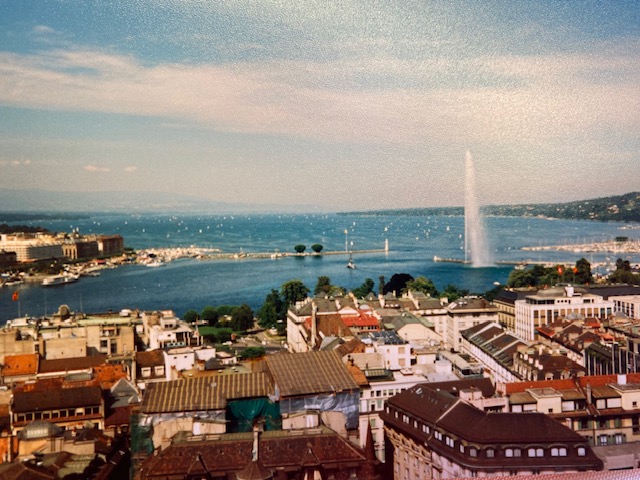
The week in the Alps was a hard act to follow and things felt a little less exciting back in Geneva. Ariane’s parents went back to work, her sister did her own thing and I think Ariane and I must have visited every single museum Geneva had to offer (and it does has a vast array).
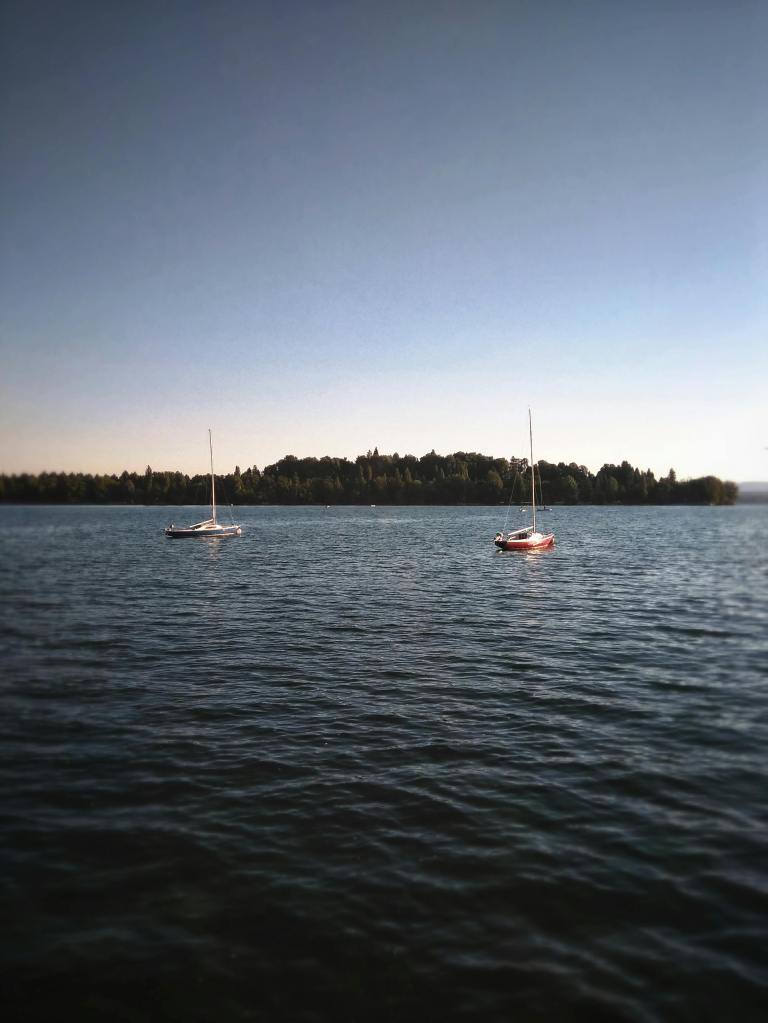
As if I hadn’t had a busy enough summer already, two weeks after returning to England I was off again – on my seventh AND FINAL exchange, to stay with the family near Lake Constance (or Bodensee, as it’s known in Germany).
Exchange No 7: Germany (Bodensee) – August 1993
This exchange was also arranged privately, through an old friend of my mum’s, a lovely German lady from Mannheim. Her daughter had a friend who lived in a town called Radolfzell-am-Bodensee.
This friend had a daughter, Janin, or Nini for short, who was two years younger than me and with whom I did the exchange.
Frau M, Nini’s mother, was one of the most horrible people I have ever met. Nini was unfortunately a carbon copy of her, and the man of the house, Herr M, was tall and I suppose quite handsome, but kind of ambivalent.
It was definitely his wife who wore the trousers in that relationship. Actually, she mostly wore tiny miniskirts, paired with awful stiletto heels that she seemed barely able to walk in.
Nini had an older sister, Mailin, but she had a boyfriend who lived near Munich so was rarely at home.
The family was certainly not short of a bob – or should that have been a Deutschmark – or two. They had a big house spread over several floors, two shiny Mercedes (and Mailin had her own pink convertible) and went on holidays to the Caribbean.
Both daughters were junior tennis champions – whereas the only tennis I was into was watching Wimbledon on TV.
Nini had long, flowing, platinum blonde hair, was very tall for her age, slim and leggy (which she liked to emphasise with teeny-tiny miniskirts, like her mother). She definitely looked a lot older than 15.
For the first couple of days, everything seemed fine. The family were fairly welcoming, Radolfzell looked like a pleasant enough place, and the lake was beautiful.
However, things were soon to change.
Being late August, German schools had already gone back. The family asked me if I wanted to go to school every morning with Nini, or stay at home.
With my mock English, French and German A levels looming, I had a lot of reading to do in the holidays so I said I’d prefer to stay at home and study.
This worked for a couple of mornings. On the third day, Nini went off to school as usual and I stayed in my bedroom, reading, until Frau M called me from downstairs.
I went downstairs and suddenly, she was shouting at me. I was absolutely gobsmacked.
She was ranting about how I just stayed in my room the whole time and that she’d had enough of my “rudeness” and from now on I didn’t have a choice: I was going to school with Nini EVERY DAY, like it or not, and had to do whatever Nini did.
I burst into tears.
Then Frau M informed me we were going out. I got into the car, still sobbing.
We went somewhere – I think she had a doctor’s appointment, as I remember sitting in a waiting room for quite a long time – still sobbing.
We then met up with Herr M and Nini, for lunch in a restaurant, and I managed to sob my way through the meal.
Back in the car afterwards, I was still crying.
Frau M had clearly had enough by now, because I remember her turning around in the car and yelling at me: “HÖR AUF ZU WEINEN!!!” (STOP CRYING!!!!).
That’s one German phrase that’s been etched on my memory ever since.
“I remember Frau M yelling at me ‘HÖR AUF ZU WEINEN!!!’ (STOP CRYING!!!) – that’s one German phrase that’s been etched on my memory ever since”
After that, my time in Radolfzell-am-Bodensee became like a nightmare.
I remember getting bitten all over by mosquitoes at night (OK, probably not the family’s fault….) and having allergic reactions to the bites, with huge swellings on my arms and legs, so we had to go to a pharmacy to get some antihistamine cream.
I put the tube on the floor beside the sofa-bed I was sleeping on (there was no bedside table), forgot it was there and inadvertently stepped on it later, squirting cream on their spotless carpet.
I immediately told Mailin, who must have cleared it up, but not without the whole family sitting there bitching about it in front of me at dinner that night (I think they assumed I couldn’t understand, but I could), and Nini tutting and looking at me like I was something the cat had brought in.
Speaking of cats, the family had one, and she became my only ally.
At the weekend, I went with Nini and her parents to Mainau, an island on the lake which had lovely gardens with bushes cut in the shapes of animals and birds.
If I’d been with people who were actually pleasant, it would have been quite enjoyable.
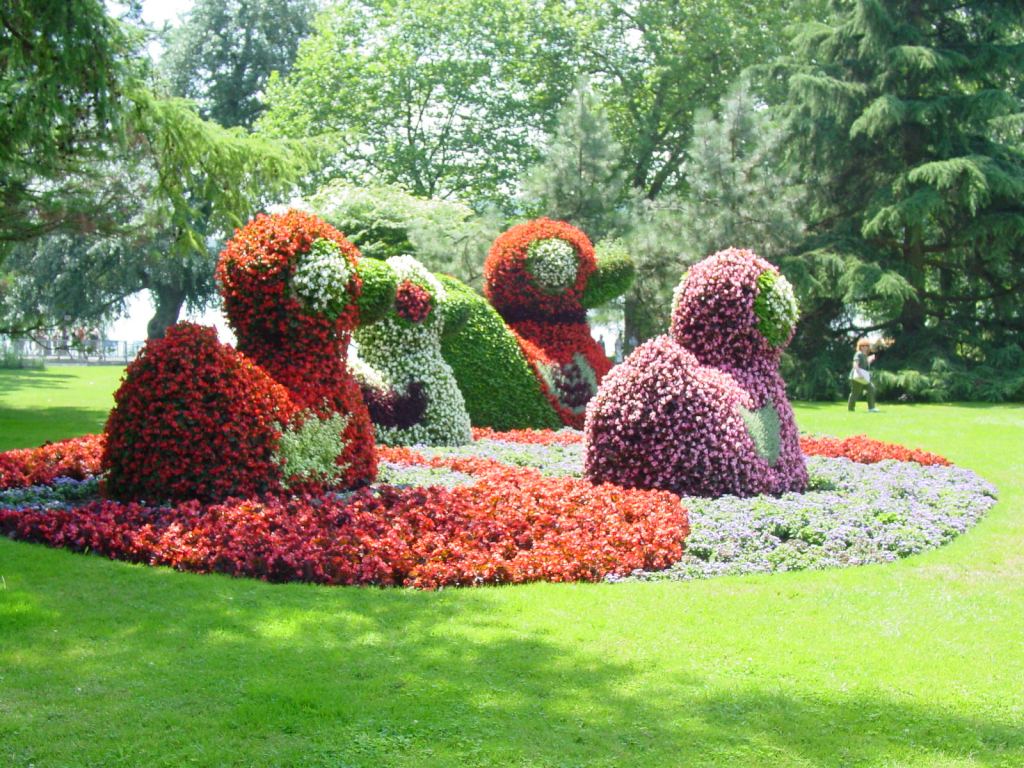
As it happens, I felt miserable. Then, to add to my misery, when we got home, a neighbour knocked on their door and told the family that, regrettably, while we’d been out, their cat had been hit by a car and had a broken leg.
Well, the Scheisse hit the fan.
Of course, it was my fault: if they hadn’t taken me out, they’d have been at home and the cat wouldn’t have been injured.
“The Scheisse hit the fan. Of course, it was my fault: if they hadn’t taken me out, they’d have been at home and the cat wouldn’t have been injured“
Another dinner time of tut-tutting and glaring looks in my direction while they slagged me off to each other as if I wasn’t there. (Luckily, apart from her broken leg, moggy was fine.)
Another time, I spent the day traipsing after Nini as took part in a tennis tournament – it was so boring.
They also gave a lift to a Russian teenager who was taking part. At one point they stopped to visit some friends, and instructed me and the Russian girl to stay in the car while they went into the house.
I can’t remember how long they left us in there for, but it was long enough for me to be able to have a decent conversation with the girl, the first person who’d spoken to me properly for days!
Somehow, the 10 days – which felt like 10 months – eventually came to an end and my penultimate day beckoned.
That night, we drove right round Lake Constance (which is pretty big), almost as far as the Austrian border, to have dinner with some friends of theirs in a typical Bavarian restaurant.
The friends brought another family along who didn’t know Nini’s family – a couple and their daughter, who looked to be a similar age to me.
Towards the end of the meal I got up to go to the bathroom and, as I was washing my hands, the daughter of the other family came in.
We hadn’t talked at the table as I wasn’t sitting near her, so she asked me what I was doing there and how long I’d been staying with that family.
Before I knew it, I was pouring out my heart to her (in German, natürlich) about everything that had happened and how truly horrible the family had been to me.
“Before I knew it, I was pouring my heart out to her in German about everything that had happened and how truly horrible the family had been to me”
I think she was aghast at my revelations, and I remember her mum coming in looking for her (since, presumably, she had spent so long in the toilets!) and also getting roped into my outpouring.
Both of them just stood there listening as I described my 10 long days of misery and homesickness, making very sympathetic noises and looking concerned.
There was nothing they could do, either – but it felt so cathartic to be able to get it all off my chest, and good to know there were some kind people in the world after all.
Of course, if this happened these days, I’d have no doubt been texting my parents from the get-go, telling them how awful it was and could they please change my flight so I could come home straight away.
But in the days of only having a landline in the house, and my parents naturally thinking they didn’t need to call me unless they heard from me (no news being good news, in other words) – there was no contact at all.
Nini returned the visit to us the following October as planned, and coincided with Martin.
Luckily I didn’t see much of her, as I had school and she spent most of her time going clothes shopping in London.
Anyway, I preferred to spend my time with Martin, who turned out to be good company, and quite funny when he was away from his family.
Did doing all these exchanges help with my languages? They certainly helped “enrich” my life experiences and yes, they definitely sharpened my language skills, particularly the more enjoyable exchanges (you learn best when you’re having fun, after all).
But I think seven was a bit excessive.
Still, if my son’s school was to offer an exchange to a French-speaking country, I know he’d jump at the chance – despite knowing my stories!
Did you do language exchanges at school? Did you get on with your families? What are your main memories? I’d love to hear about them!

